The double slit experiment, part 1: the background
A conceptual walkthrough of diffraction and interference in the classical wave picture, the quantum double-slit thought experiment with single photons, and Feynman’s neutron-scattering-crystal analogy for which-path information.
The quantum double-slit experiment
In this series we’ll eventually be using numerical and analytical methods for simulating and solving for the result of the famous quantum mechanical double-slit experiment, performed with an electron and solved in a variety of different ways.
I like this problem a lot, as it illustrates some really interesting quantum phenomena (wave-particle duality, superposition, interference, uncertainty, measurement), and you can layer on the complexity, as we’ll do here in discrete and progressive steps.
I’ve separated this series into different posts for a reason: Part 1 has basic prerequisites and the others require a significant background in math or physics concepts that are taught at the upper-undergraduate or graduate level.
Part 1: the background
This first part is very light on the math. We’ll try to build an intuition for the experiment using analogies with light, then we’ll look at electrons. My hope is that you’ll come away with some understanding of wave-particle duality and “the observer effect” in quantum mechanics.
Classical picture: light
Many of you may know that light has both particle- and wave-like properties. A photon is an “atom” of light, an indivisible and smallest packet of light that exhibits particle-like behavior. However, light at a macroscopic level - and that which we encounter in our daily life - behaves as a wave. And waves exhibit two phenomena that are critical to understanding the double-slit experiment: diffraction and interference.
Diffraction
If you shine a laser from a distance onto a piece of paper with a tiny little pinhole in the middle, most of the light will be absorbed or reflected by the surface of the paper, and some will make it through the hole. If you have a second piece of paper behind the first (call it the “detector screen”), you’ll see that the transmitted light that goes through the hole spreads out a little bit. The dot on the paper on the detector screen will be slightly wider then the initial, incoming beam. The highest intensity of light on the detector will be in the center of the dot. As you work your way outward from the center, the intensity decreases until it dies off. This spreading out is known as diffraction, and is due to light bending around the sides of the hole.
Interference
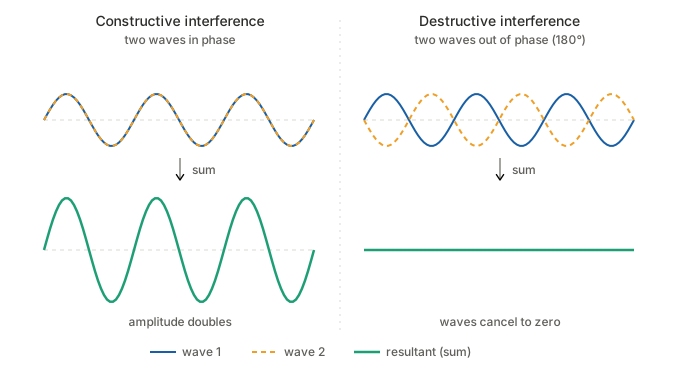
Waves are basically just oscillations of something, ups and downs in a repeating pattern. The peaks and troughs of light correspond to peaks and troughs of electric and magnetic fields, but that’s out of scope for this post. All you need to know is that two beams of light that overlap will, generally, interfere. Roughly, when a peak overlaps with a peak, the intensity of the light increases. Same with a trough overlapping a trough. But when a peak and a trough overlap, they cancel each other out and you get no light at all.
Classical double-slit
Combining the above two concepts, take a look at the following diagram and first see if you can reason about the result on your own.
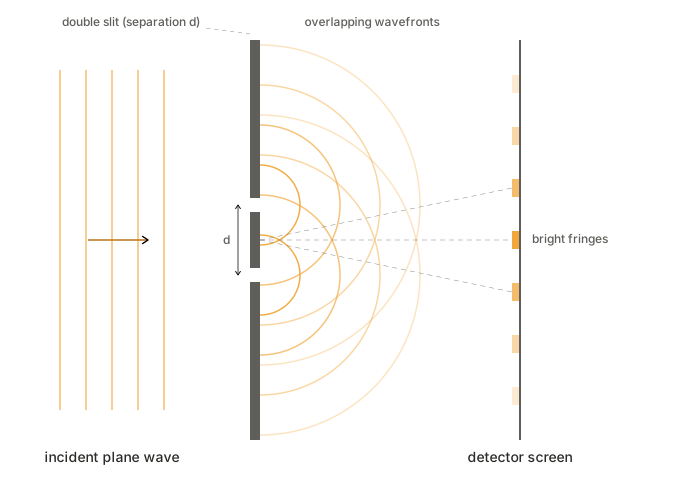
Diffraction causes the bending of the light going through each slit, and interference causes the regions of high and low intensity on the detector screen. The end result is these “fringes” you see on the detector screen. The fringes themselves are physically where the waves of diffracted (spread-out) light overlapped and interfered constructively. The regions in between are where no light arrived because the waves interfered destructively and canceled out.
Quantum picture: also with light
Let’s now focus on the particle-like properties of light. The particle behavior of light, by the way, is inherently “quantum.” No classical theory can explain phenomena like the photoelectric effect or other experiments where photons’ particle-like behaviors dominate. So just remember this: light’s “quantumness” is roughly indicated by how much it’s behaving like a particle. For matter - including the electrons we’ll be dealing with - the opposite is true: the wave behavior only comes on when quantum effects dominate.
Aside: this second statement is crucial to understanding the profundity of the results we’re going to see. Because it turns out that the quantumness disappears whenever you try to figure out the particle’s state (“observe” it).
Let’s make our detector screen a theoretical, 2-dimensional screen that can detect where a single photon lands. When the light is on full blast like in the above experiment, the detector will detect a large number of photons over a given (short) timespan. The resulting pattern will exhibit wave interference, as we described before: you’ll see fringes with bright areas and dark areas. This is fully classical so far. Waves diffract when they hit the slits, and interfere when they recombine.
However, now dial down the light intensity to be sufficiently low that single photons arrive sequentially at the detector screen, passing through either the top or bottom slit (or… both or neither, as we’ll see). Okay, so admittedly this is really a semi-classical picture since we’re dealing with individual photons. But hear me out. Classically, we would expect the screen to have two blotches where the photons hit the screen, each directly, line-of-sight behind one of the slits. We wouldn’t expect interference, since each photon passes through sequentially with no overlap.
BUT, we in fact do see the interference fringes on the screen, provided we don’t set up a way to detect which slit each photon went through. I’ll get to the mathematics and maybe even philosophy of what happens when the observer (us) detects which slit the photon passed through. But for now, take it as a given that this is the case.
Let’s stop for a moment and appreciate how crazy this is: individual photons shot at the screen, one by one and, result in that interference pattern. If the photon went through a slit, there’s no second photon to overlap or recombine with. How is it possible for there to be interference? As we’ll eventually see, the photon essentially went through both slits simultaneously, and interfered with itself before hitting the detector. But wait, there’s more! If you somehow determine whether each photon went through the top or bottom slit, the pattern disappears, and we get that classical two-smudge pattern!
Note: if we’re being pedantic, we might say that the path the light took is indeterminate if you don’t measure it, and that it’s the trajectories or possible paths that interfere. I, for one, don’t think this makes things any less magical. But I also think my previous description is better for our layperson understanding of this.
Quantum picture: electrons
Let’s now turn to the actual experiment of interest: a double-slit setup with an electron beam instead of a light beam. Now prior to quantum theory, there were two disparate theories to describe particles and waves. These are (somewhat loosely) the fields of classical mechanics and wave mechanics. Whether you’re dealing with sound wave propagation, light, or a spreading circular wave in water, you use a different set of equations than if you’re looking at particles with mass. The equations of motion in both cases give you the state of the system at some time \(t\) in the future, provided you know the initial state of your particle(s) or wave(s).
This is adequate for almost everything we interact with in our daily lives. Single electrons, however, are so tiny and interact so differently with each other and light or matter that we need quantum theory to calculate their trajectories and interactions.
And so when we fire electrons at the screen, we might know what to expect: fringes on the detector if quantumness was preserved, or smudges with no fringes if the quantumness disappeared. This is indeed the case! If we don’t observe which slit the electron went through, we see fringes. If we somehow figure out the trajectory and which slit the electron passed through, the quantumness and fringes disappear!
The nature of measurement and uncertainty
As I said before, wave-like properties of all matter are inherently quantum mechanical. Quantum theory predicted this, and there’s no way to explain the double-slit experiment in terms of classical particles or trajectories. The interference pattern, being the fingerprint of wave-like behavior, is therefore also an indication of “quantumness.” And that’s the thing we see disappearing when we make an “observation.”
What constitutes a measurement or observation? This is tricky. You could think of it in this context as altering the trajectory physically by e.g. blocking the lower slit. Or light from a microscope shining on the electron at all times throughout its journey. But more interesting is the case of designing an extremely sensitive apparatus to detect which slit the electron went through without significantly altering its trajectory. Since electrons carry charge, this might be an instrument placed right after the slits and closer to the top slit that detects the strength of its electric field to determine the slit it went through. But the details and mechanism don’t actually matter. There is no way to design an instrument that can detect which slit the electron went through in this experiment and preserve its quantumness. And there’s even a way of quantifying how “strong” or “weak” a measurement is, and it’s inversely related to the quantum decoherence - that is, the weaker the measurement, the more the quantumness is preserved.
So the main takeaway here is that if we know which slit the electron traveled through, it will behave like a particle. If we don’t, it will behave like a wave.
For the interested reader, there’s actually a much stronger statement here: the very ability even in principle to know what a particle’s trajectory is or was alters that trajectory. And there’s truly no way to “cheat” and skirt this universal principle, even by being extremely clever with our experimental setup. It’s simply not possible to preserve the “quantumness” and have the information we’re seeking. I find this profound and fascinating.
To drive the point home I’ll borrow a thought experiment from Richard Feynman’s lecture notes on quantum mechanics. Feel free to skip this next section if it isn’t of interest, or is too much to grasp. It does require some prior physics knowledge.
Here I will quote Feynman rather than paraphrasing. After all, I could never do it justice with my own description. For reference, I’m quoting from his third section of Caltech lecture notes.
Our next example is a phenomenon in which we have to analyze the interference of probability amplitudes somewhat carefully. We look at the process of the scattering of neutrons from a crystal. Suppose we have a crystal which has a lot of atoms with nuclei at their centers, arranged in a periodic array, and a neutron beam that comes from far away. We can label the various nuclei in the crystal by an index i , where i runs over the integers 1 , 2 , 3 , …, N , with N equal to the total number of atoms. We have here a large number of apparently indistinguishable routes. They are indistinguishable because a low-energy neutron is scattered from a nucleus without knocking the atom out of its place in the crystal—no “record” is left of the scattering.
[Skipping some math here]
Because we are adding amplitudes of scattering from atoms with different space positions, the amplitudes will have different phases giving the characteristic interference pattern…
The neutron intensity as a function of angle in such an experiment is indeed often found to show tremendous variations, with very sharp interference peaks and almost nothing in between—as shown [here]
. However, for certain kinds of crystals it does not work this way, and there is—along with the interference peaks discussed above—a general background of scattering in all directions. We must try to understand the apparently mysterious reasons for this. Well, we have not considered one important property of the neutron. It has a spin of one-half, and so there are two conditions in which it can be: either spin “up”… or spin “down.” If the nuclei of the crystal have no spin, the neutron spin doesn’t have any effect. But when the nuclei of the crystal also have a spin, say a spin of one-half, you will observe the background of smeared-out scattering described above. The explanation is as follows.
If the neutron has one direction of spin and the atomic nucleus has the same spin, then no change of spin can occur in the scattering process. If the neutron and atomic nucleus have opposite spin, then scattering can occur by two processes, one in which the spins are unchanged and another in which the spin directions are exchanged. This rule for no net change of the sum of the spins is analogous to our classical law of conservation of angular momentum. We can begin to understand the phenomenon if we assume that all the scattering nuclei are set up with spins in one direction. A neutron with the same spin will scatter with the expected sharp interference distribution. What about one with opposite spin? If it scatters without spin flip, then nothing is changed from the above; but if the two spins flip over in the scattering, we could, in principle, find out which nucleus had done the scattering, since it would be the only one with spin turned over. Well, if we can tell which atom did the scattering, what have the other atoms got to do with it? Nothing, of course. The scattering is exactly the same as that from a single atom.
If you have an appetite for math and want to peak under the cosmic hood, feel free to continue with this series. If not, thanks for stopping by! I hope you feel a little more informed and maybe a little excited about the universe.
Up next
In Part 2 we’ll put this intuition into math: solving the Schrödinger equation for a Gaussian electron wave packet passing through two Gaussian-aperture slits, and deriving the resulting interference pattern in closed form.
The full source for this series is on GitHub. The derivations, code, and prose are all mine. However, I did consult Claude to proofread and for help setting up the project and rendering equations.